





Nikkei Business Publications, Inc. Bookmark
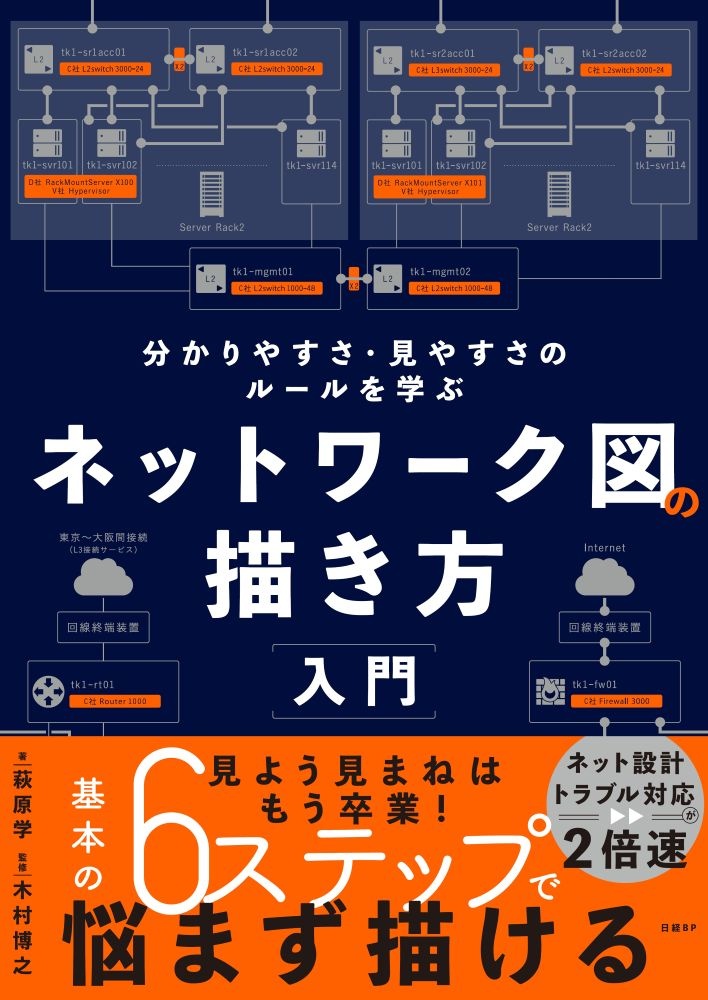
Introduction to Drawing Network Diagrams: Learning the Rules for Clarity and Readability
Information will be available after you log in. Please create an account.
Rights Information
Other Special Conditions
Abstract
Introducing a "textbook" that teaches you how to systematically draw network diagrams.
No more copying! Draw with ease in six basic steps.
Network diagrams (network configuration diagrams) can be thought of as "maps" that make it easy to understand how the terminals and communication devices that make up the Internet or a corporate LAN are connected. They are useful for a variety of tasks, including design and operation, troubleshooting, and investigating the scope of impact in the event of a cyber-attack.
This book explains how to draw and read network configuration diagrams, as well as the basic knowledge required for doing so. It then explains the six necessary steps and the elements that need to be organized, along with examples of drawing actual network configuration diagrams.
A network engineer who has drawn many network diagrams on the front lines and has also given lectures on "how to draw network configuration diagrams" clearly explains the tips for drawing for beginners.
[Recommended for]
- People who are struggling with how to draw network configuration diagrams
- People drawing a network configuration diagram for the first time
Author’s Information
Expert, IT Platform Technology Planning Department, TIS.
Born in Hokkaido in 1980. Graduated from the Graduate School of Engineering, Hokkaido University, Department of Systems and Information Engineering, in 2005. After joining a systems integrator, he worked as a network specialist in the design and construction of data center services and private clouds. Drawing on his on-site experience, he tackled the challenge of "how to express complex networks in an easy-to-understand manner." He then joined the R&D department, where he was responsible for researching the latest network technologies and conducting verification activities for new businesses. Since 2018, he has been working at TIS Inc., promoting R&D and technology planning for IT system infrastructure. He is particularly focused on automation and operational efficiency, centered on modeling system configuration information, and has also worked on network topology modeling and visualization methods for configuration diagrams. Sharing his practical experience and knowledge of data visualization on "Qiita" led to the writing of this book. He is currently conducting research into verification automation using "network digital twins," and is widely sharing his practical knowledge and know-how through presentations at JANOG and other events.
| Series/Label | --- |
|---|---|
| Released Date | Dec 2025 |
| Price | ¥3,000 |
| Size | 182mm×257mm |
| Total Page Number | 192 pages |
| Color Page Number | --- |
| ISBN | 9784296207381 |
| Genre | Technology / Engineering / Computers > Technology/Engineering/Computers |
| Visualization experience | NO |